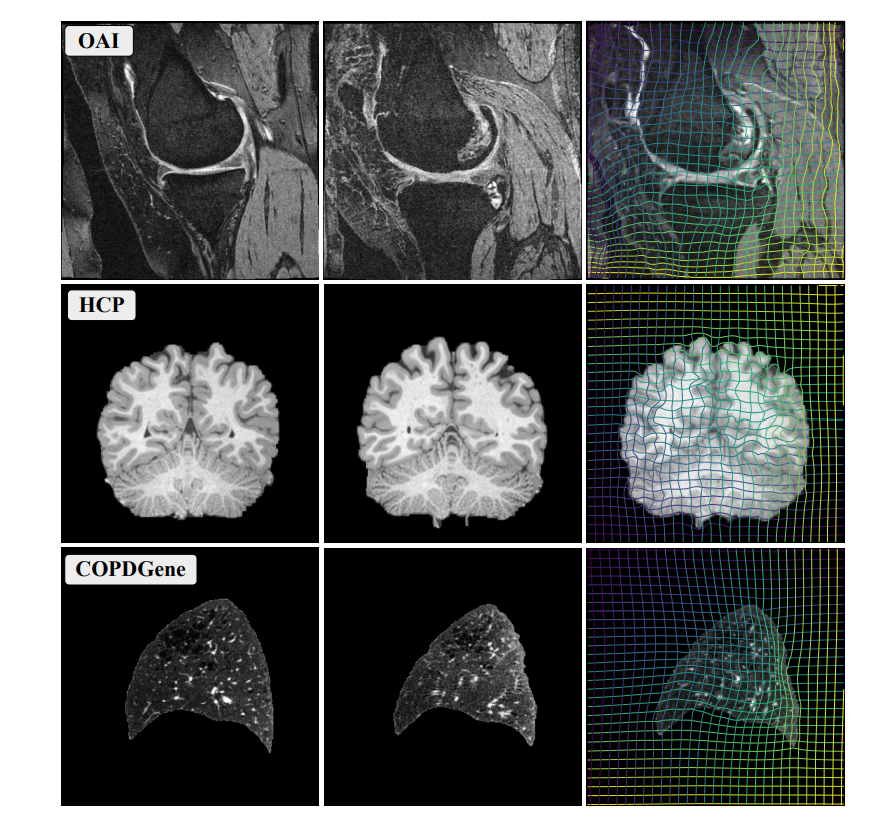
Spatial Perception & Registration
Algorithmic foundations for spatial correspondence and deep learning-based medical image registration.
Spatial perception is the foundation of spatial intelligence: before an AI system can understand or reason about anatomy, it must first estimate how structures correspond and deform across images and time.
My research develops the algorithmic foundations for spatial correspondence and alignment, including transformation regularization, similarity learning, and uncertainty estimation. These components form the infrastructure for building reliable and generalizable spatial models in medical imaging.
Transformation Regularization
I study how to represent and regularize deformation fields so that they are physically plausible, diffeomorphic, and generalizable across datasets and anatomies.
GradICON (Tian et al., 2023) achieves state-of-the-art diffeomorphic registration via gradient inverse consistency regularization.
NePhi (Tian et al., 2024) represents deformation fields as neural implicit functions for memory-efficient high-resolution registration.
CARL (Greer et al., 2025) introduces an equivariance framework for image registration.
Similarity Measure
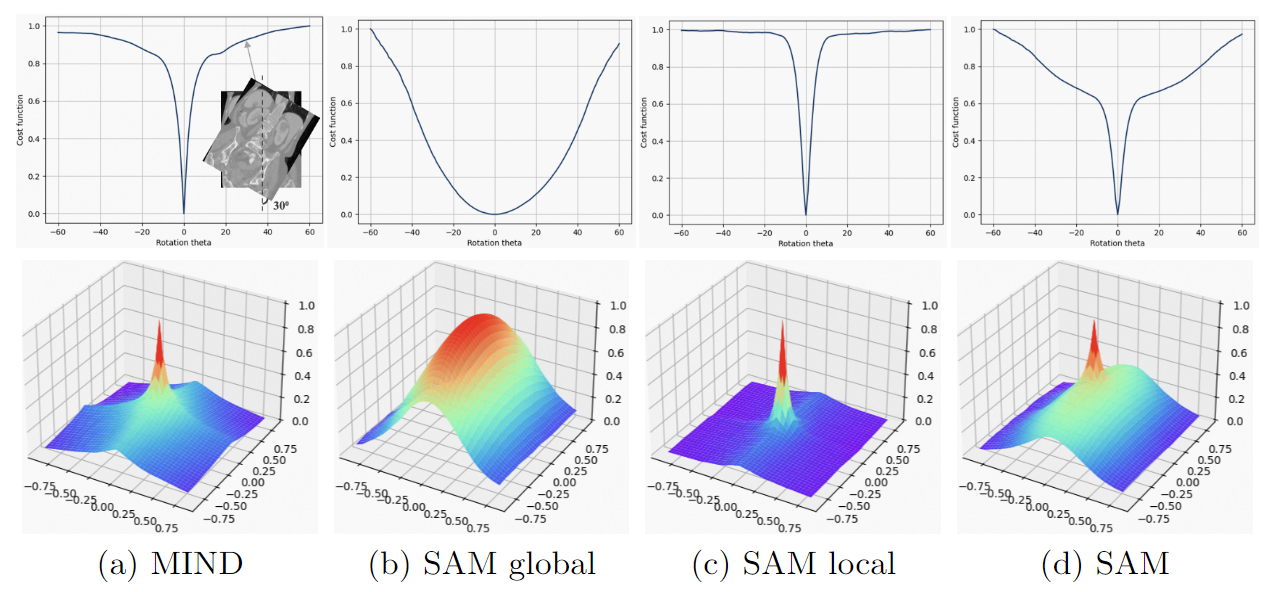
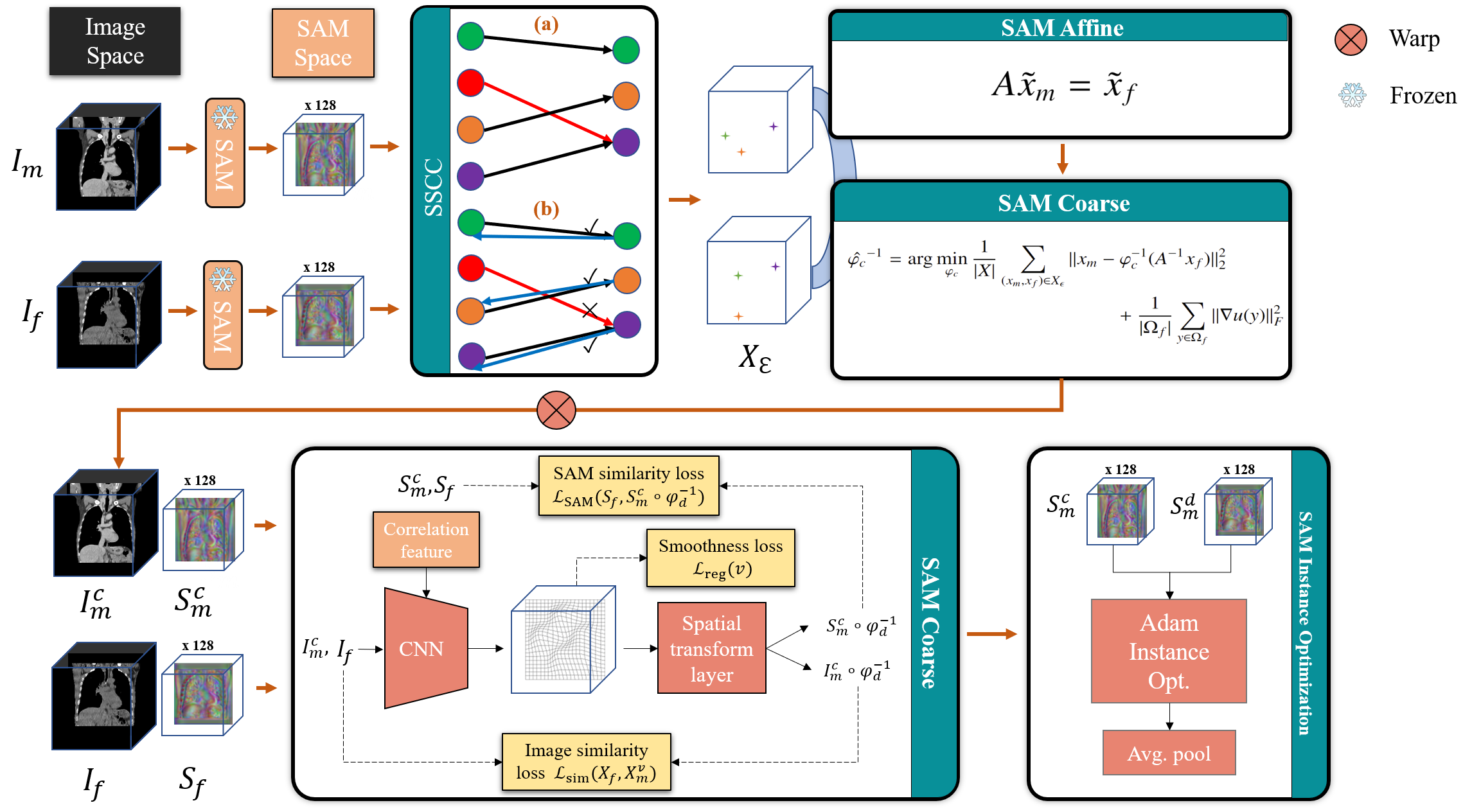
I study how to measure anatomical similarity across images, especially across modalities where intensity values are not directly comparable.
SAMConvex (Li et al., 2023) and SAME++ (Tian et al., 2023) leverage self-supervised anatomical embeddings for fast and accurate cross modality registration.
Uncertainty Estimation
I study how to quantify the uncertainty of spatial correspondence, which is critical for clinical decision-making and downstream tasks.
I propose test-time uncertainty estimation (Tian et al., 2026) via transformation equivariance.
References
2026
- arXiv
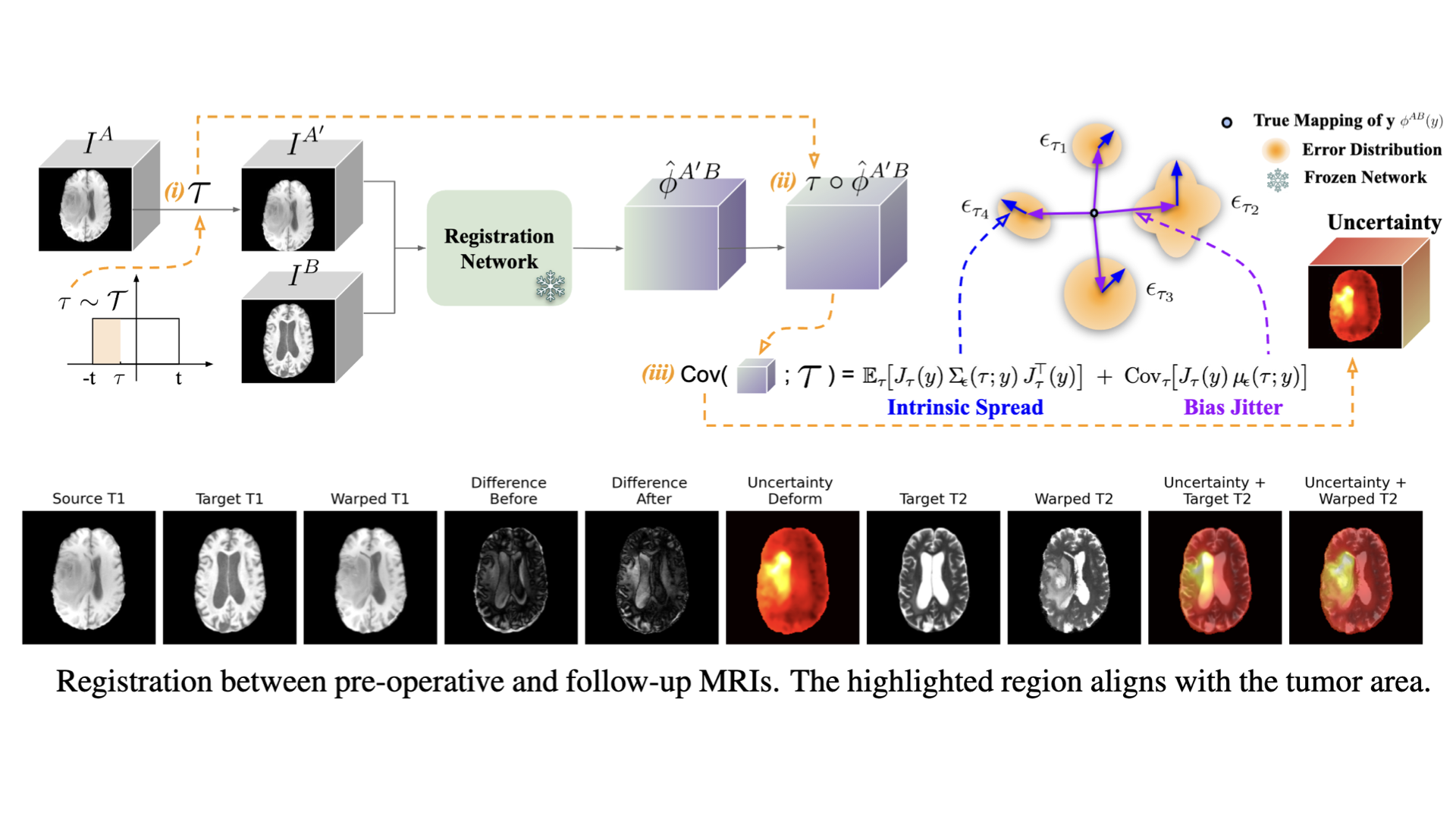 Test-time Uncertainty Estimation for Medical Image Registration via Transformation EquivariancearXiv preprint arXiv:2509.23355, 2026
2025
- CVPRCARL: A Framework for Equivariant Image RegistrationIn Proceedings of the IEEE/CVF Conference on Computer Vision and Pattern Recognition, 2025
2024
- ECCV
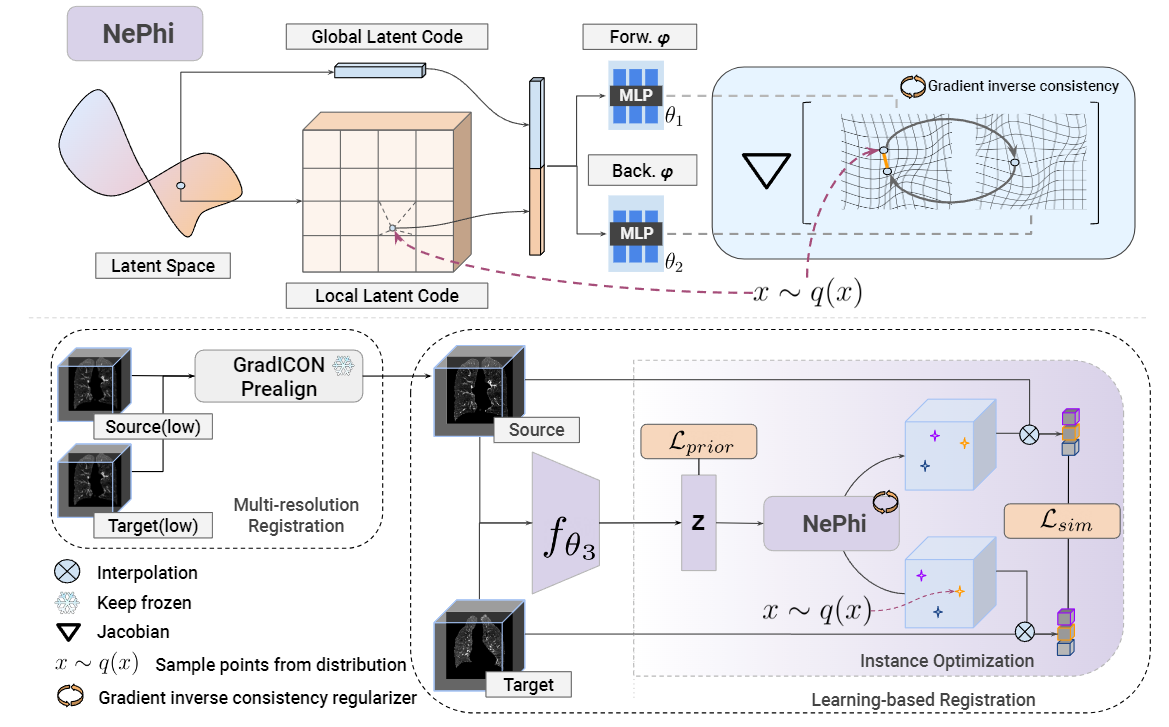 NePhi: Neural Deformation Fields for Approximately Diffeomorphic Medical Image RegistrationarXiv preprint arXiv:2309.07322, 2024ECCV 2024